
ADVERTISEMENT
ADVERTISEMENT
ADVERTISEMENT
I Watched Wealthy Customers Mock an Old Biker for Counting Coins — Then I Learned Why Those Coins Meant Everything
It was supposed to be an ordinary Sunday morning.
I was sitting alone in an expensive coffee shop, waiting for my boss to arrive for a meeting. The place was the kind where a simple latte cost nearly as much as lunch and people casually wore watches worth more than my car.
I had arrived early.
My boss was late.
So I sat in the corner, drank my coffee, and watched the room.
Then an old biker walked through the door.
At first, nobody paid much attention to him.
But within minutes, he became the target of some of the cruelest people I had ever encountered.
And by the end of that morning, I would discover that the handful of coins in his pocket carried more love and meaning than all the money those people had spent their lives collecting.
The Old Biker Walked Into the Coffee Shop
He looked like someone who had spent most of his life on the road.
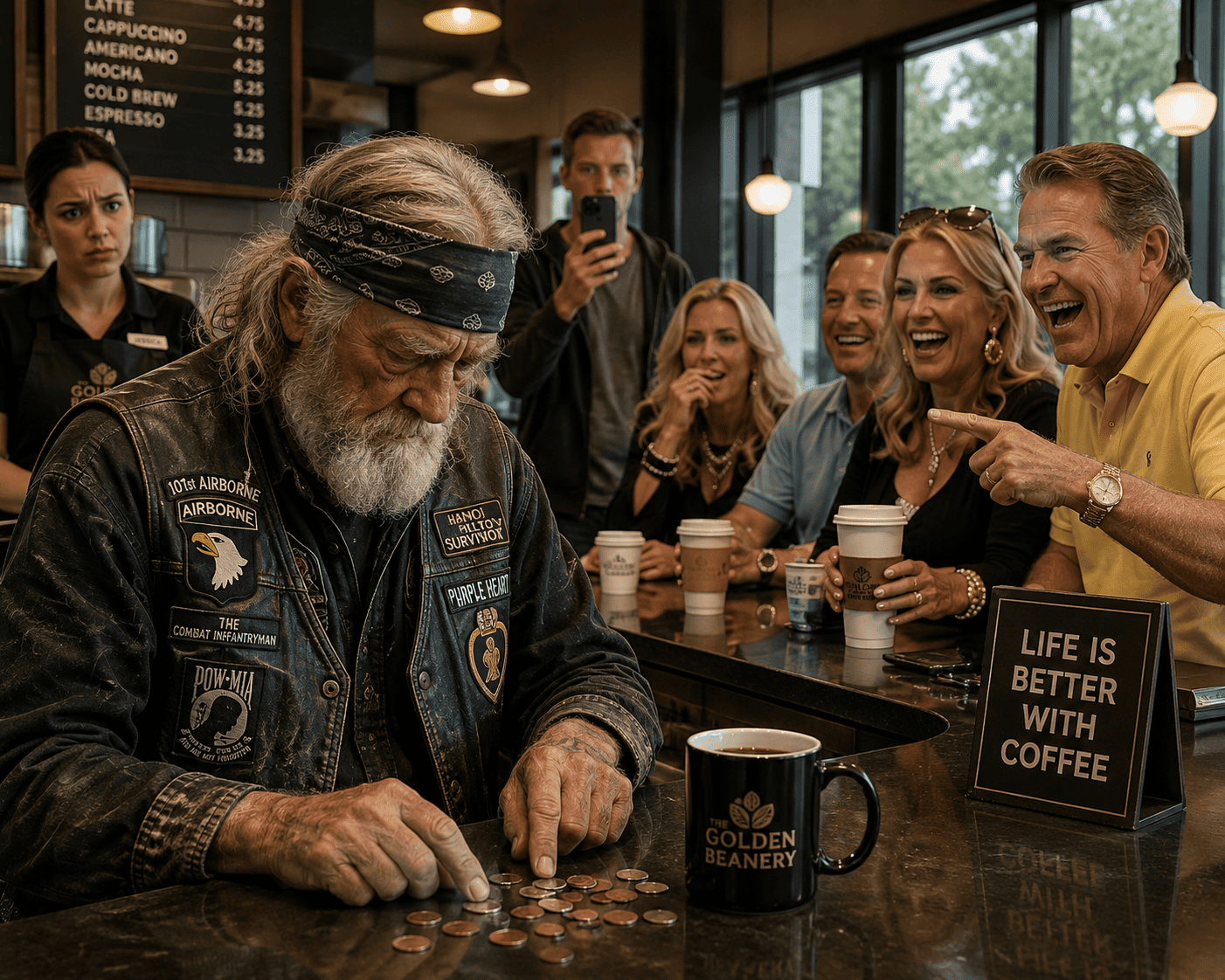
His leather vest was worn and covered in patches. A faded bandana rested beneath his gray hair, and his boots looked like they had traveled thousands of miles.
His beard was long and silver.
His face was weathered.
He walked slowly toward the counter.
The barista forced a polite smile.
“Can I help you?”
“Just a small black coffee, please,” he said quietly.
“That’ll be four seventy-five.”
The old man reached into his pocket.
Then he placed a handful of change on the counter.
Quarters.
Dimes.
Nickels.
Pennies.
With slow, arthritic fingers, he began counting.
“One dollar…”
Then another.
And another.
That was when the laughter began.
The Wealthy Customers Started Mocking Him
A group of four people sat near the counter.
Two men.
Two women.
They had spent the entire morning talking loudly about expensive vacations, country clubs, investments, and luxury homes.
One of the women looked toward the old man and laughed.
“Is he seriously paying in pennies?”
One of the men snickered.
“Maybe someone should tell him the homeless shelter is down the street.”
The old biker heard them.
I saw his shoulders tense.
But he kept counting.
“Four twenty-five…”
“Four thirty…”
“Four thirty-five…”
“This is painful to watch,” another woman said. “Some people shouldn’t go out in public if they can’t afford it.”
The barista looked uncomfortable.
But she said nothing.
The old man continued.
“Four fifty…”
“Four sixty…”
Then one of the men stood up.
He walked toward the counter and pulled out his wallet.
Inside were several large bills.
He made sure everyone could see them.
“Here,” he said loudly. “Let me help you out.”
Then he smiled.
“I’ve got plenty of money. Unlike some people.”
His friends laughed.
The old biker stopped counting.
For the first time, he looked directly at the man.
“I can pay for my own coffee,” he said.
The man laughed again.
“Clearly, you can’t.”
Something inside me snapped.
I had been recording the situation on my phone without really knowing why.
But now I stood up.
I Finally Stepped In
“Stop.”
The entire coffee shop became quiet.
Everyone turned toward me.
I walked to the counter.
“I’ll pay for his coffee,” I said.
Then I turned toward the group.
“And you should all be ashamed of yourselves.”
One of the men laughed.
“Oh, great. Another hero.”
I looked at the old biker.
Then I looked at the patches on his vest.
I had recognized them the moment he entered.
“Do you people have any idea who you’re laughing at?”
One of the women crossed her arms.
“He’s an old biker who can’t afford coffee.”
I pointed toward one of the patches.
“That symbol represents the Combat Infantryman Badge.”
The laughter stopped.
I pointed toward another.
“That one is a Purple Heart.”
The expressions around the room began to change.
Then I pointed toward the patch on his shoulder.
“The 101st Airborne Division.”
Nobody spoke.
Finally, I looked at another patch.
It included words that made the meaning of the others impossible to ignore.
Hanoi Hilton Survivor.
The coffee shop went completely silent.
I turned toward the old man.
“Sir,” I asked quietly, “am I understanding your patches correctly?”
He stared at me for several seconds.
Then he nodded.
The Truth About Walter
“Five years,” he said quietly.
Nobody moved.
“Five years, three months, and eleven days.”
His voice was calm.
But the entire room listened.
“That was how long they held me.”
He explained that he had been imprisoned during the Vietnam War.
He had survived starvation, brutal conditions, and years of captivity.
“When I was released,” he said, “I weighed eighty-nine pounds.”
The people who had been laughing moments earlier looked completely different now.
Their confidence had disappeared.
One of the women tried to speak.
“We didn’t know…”
I turned toward her.
“Would it have been acceptable if he wasn’t a veteran?”
She said nothing.
That was the point.
You shouldn’t need to know someone’s accomplishments, sacrifices, or history before deciding they deserve basic respect.
The old man deserved kindness before anyone knew who he was.
His military service didn’t make cruelty toward him wrong.
It simply exposed how quickly those people had judged someone they knew absolutely nothing about.
His Name Was Walter
I paid for his coffee.
Then I offered to buy him breakfast.
The old man placed his hand on my arm.
“You don’t have to do that, son.”
“I know,” I told him. “I want to.”
He smiled.
“Name’s Walter.”
We shook hands.
His grip was surprisingly strong.
Then he asked me to join him.
We sat near the window, and before long, the barista brought Walter a full breakfast.
When I tried to pay, she refused.
“It’s on the house,” she said.
Then she looked at Walter.
“I’m sorry I didn’t say something sooner.”
Walter smiled gently.
“Standing up is difficult when everyone else stays quiet.”
The wealthy group left shortly afterward.
They didn’t apologize.
They didn’t look at Walter.
They simply gathered their things and walked away.
Walter watched them leave.
Then he looked at me.
“You got all of that on video?”
I nodded.
Instead of being angry, he smiled.
“Maybe someone can learn something from it.”
Why Walter Refused to Defend Himself
As we ate, I finally asked him something I couldn’t stop thinking about.
“Why didn’t you tell them who you were?”
Walter looked out the window.
For several moments, he didn’t answer.
Then he said something I will never forget.
“I spent years being told I was worthless.”
His eyes were distant.
“I learned something while I was imprisoned. Your value doesn’t come from what strangers think about you.”
He turned back toward me.
“Those people couldn’t take anything from me.”
Then he smiled.
“They could only show me who they really were.”
I sat quietly.
Walter didn’t need to prove himself.
He knew what he had survived.
He knew who he was.
And he refused to allow a group of strangers to decide his worth.
But I still had one question.
Why was he counting coins?
The Real Story Behind the Coins
Walter smiled when I asked.
“You really want to know?”
“Yes.”
His expression changed.
“My grandson gave them to me.”
I didn’t understand.
Walter reached into his pocket and pulled out the remaining coins.
“My grandson is seven years old.”
He explained that money had been tight because of medical expenses.
The little boy had overheard a conversation about it.
A few days later, his grandson walked up to him carrying his piggy bank.
“He handed it to me and said, ‘Grandpa, you helped me my whole life. Now I help you.’”
Walter’s eyes filled with tears.
Inside the piggy bank was everything the child had saved.
Thirty-seven dollars and forty-two cents.
Every coin represented time.
Every coin represented sacrifice.
Every coin represented love.
Walter looked down at them.
“I couldn’t put them away and pretend they didn’t mean anything.”
So he used them.
A little at a time.
Coffee.
Bread.
Small things.
Each time, he remembered the little boy who had willingly given him everything he had.
The people in the coffee shop had seen an old man counting coins.
They thought they were looking at poverty.
But Walter saw something completely different.
“These coins are worth more than everything those people have in their wallets,” he said.
“Why?”
Walter smiled.
“Because these coins are love.”
The Video Went Viral
Before we left, Walter looked at my phone.
“You should post that video.”
I hesitated.
“Are you sure?”
He nodded.
“Not to destroy those people.”
That surprised me.
“But maybe someone will see it and think twice before laughing at a stranger.”
So I posted it.
Within days, the video spread everywhere.
Millions of people watched Walter being mocked.
Then they watched the truth unfold.
Messages arrived from veterans, families, teachers, and complete strangers.
People wanted to thank him.
Others wanted to help.
Walter accepted the kindness but refused to let the attention change him.
He directed support toward veterans and causes that mattered to him.
His story reached thousands of people.
But Walter’s favorite reaction came from someone much closer to home.
His grandson saw the video.
Then he looked at his grandfather and smiled.
“See, Grandpa? I told you my coins were special.”
Walter told me that story later with tears in his eyes.
And I understood exactly why those words meant so much.
The Richest Man I Ever Met
Walter and I remained in contact.
We talked about life, family, motorcycles, war, and everything in between.
He told me about his wife, Margaret, who had stayed beside him through decades of difficult memories.
He told me about his daughter.
And he talked endlessly about his grandson.
One day, I asked him whether he hated the people who had mocked him.
Walter shook his head.
“No.”
“You don’t?”
He smiled.
“I feel sorry for them.”
I couldn’t understand why.
Then he explained.
“They may have more money than me. But they’ll never know what it feels like when a seven-year-old gives you everything he has because he loves you.”
He looked down at the coins in his hand.
“That kind of love makes a man rich.”
Walter eventually passed away peacefully.
His funeral was attended by hundreds of people.
Motorcycles filled the road.
Veterans stood together to honor him.
And among the final tributes was one that mattered more than any medal or ceremony.
His grandson placed thirty-seven dollars and forty-two cents in coins beside him.
“For coffee in heaven, Grandpa.”
I still think about Walter.
About the expensive coffee shop.
About the people who laughed.
About the handful of coins.
And about how quickly we can decide we know someone’s story simply by looking at them.
The truth is, we rarely know what another person has survived.
We don’t know why they count coins.
We don’t know what they lost.
We don’t know what they love.
And sometimes, the person who appears to have the least is carrying something more valuable than anything money can buy.
Walter entered that coffee shop as an old biker counting coins for a cup of coffee.
But by the time I truly understood his story, I realized something.
He wasn’t poor.
Not even close.
Walter was one of the richest men I had ever met.
ADVERTISEMENT