
ADVERTISEMENT
ADVERTISEMENT
ADVERTISEMENT
The Difference Between Green Onions, Scallions, Spring Onions, and Chives
At first glance, green onions, scallions, spring onions, and chives can look surprisingly similar. They all have a fresh green color and a mild onion-like flavor, and recipes sometimes use their names interchangeably.
But they aren’t always the same ingredient. Their appearance, flavor, texture, and best cooking methods can be quite different. Knowing which one you’re using can help you choose the right ingredient and get the best flavor from your recipe.
Let’s break down the differences so you’ll know exactly what to reach for the next time a recipe calls for green onions, scallions, spring onions, or chives.
1. Green Onions and Scallions: Are They the Same?
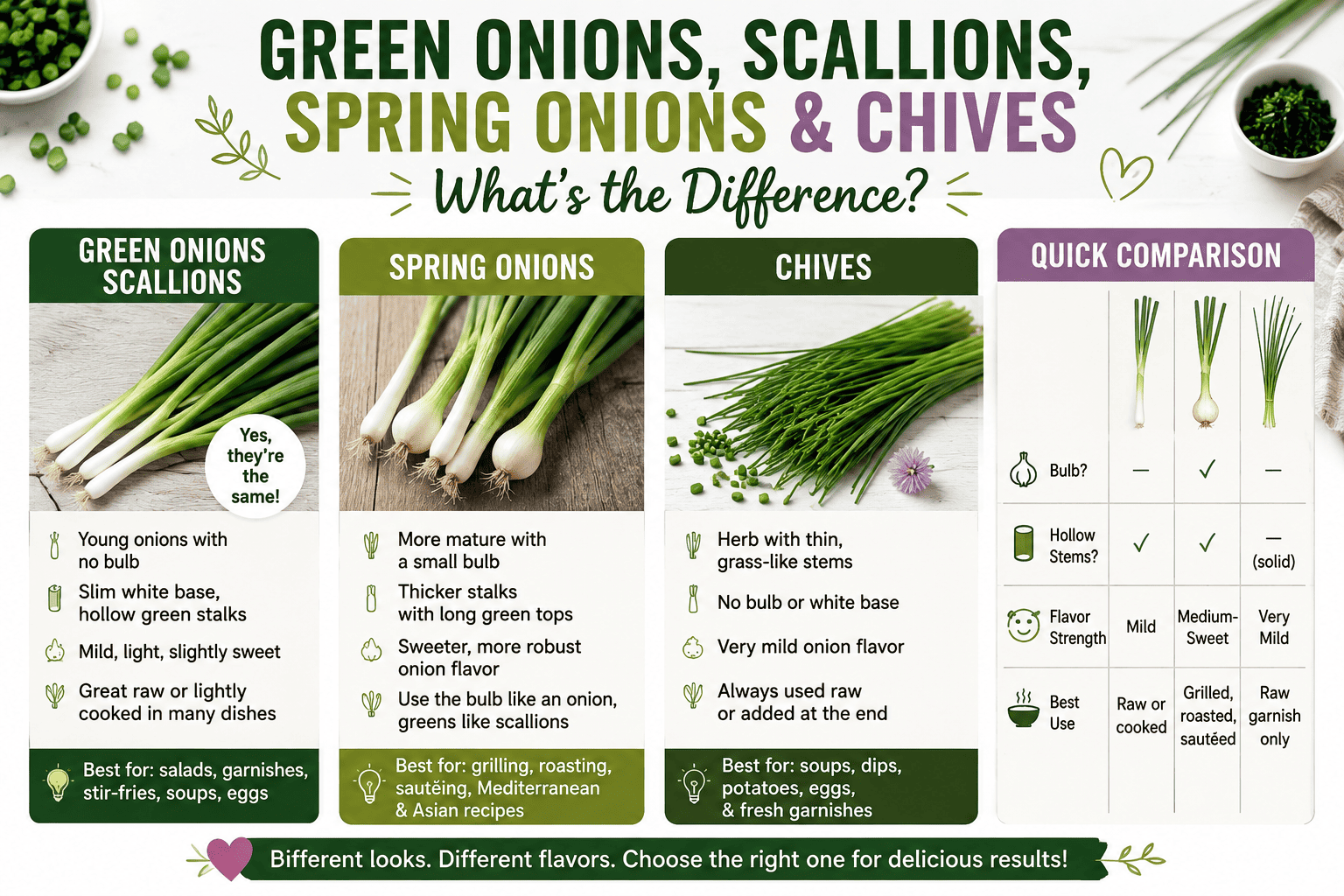
In most recipes and grocery stores, green onions and scallions refer to the same type of young onion. They are harvested before a large bulb develops.
What Do Green Onions Look Like?
Green onions typically have:
- A slim white base
- Long green stalks
- Little or no noticeable bulb
- Hollow green leaves
Both the white and green portions are edible.
What Do Green Onions Taste Like?
The white portion has a slightly stronger onion flavor, while the green tops are milder, fresher, and more delicate.
They’re much less intense than mature yellow or white onions, which makes them especially useful when you want onion flavor without overpowering a dish.
How to Use Green Onions
Green onions are incredibly versatile. You can use them:
- Raw in salads
- As a topping for baked potatoes
- In tacos and salsas
- In stir-fries
- Mixed into eggs and omelets
- In soups and noodles
- As a garnish for dips and casseroles
Tip: The white part can be cooked along with other vegetables, while the green tops are excellent for finishing a dish.
Key Takeaway
Green onions and scallions are generally two names for the same young onion.
2. Spring Onions
Spring onions are closely related to scallions, but there is one easy way to tell them apart: spring onions develop a noticeable bulb.
They are harvested when the bulb is still young and relatively small.
What Do Spring Onions Look Like?
Spring onions usually have:
- A small, rounded or slightly elongated bulb
- Thicker green stalks
- Long green leaves
- A more developed base than scallions
The exact size and shape of the bulb can vary depending on the variety and when the onions are harvested.
What Do Spring Onions Taste Like?
Because they are more mature, spring onions generally have a stronger and sweeter onion flavor than scallions.
The bulb can be used much like a mild onion, while the green tops can be treated similarly to scallions.
How to Use Spring Onions
Spring onions are delicious when:
- Grilled whole
- Roasted
- Sautéed
- Added to soups and stews
- Chopped into salads
- Used as a garnish
- Added to Mediterranean, Middle Eastern, and Asian dishes
Tip: Use the bulb when you want more pronounced onion flavor and save the green tops for a fresh finishing touch.
Key Takeaway
Spring onions have a noticeable bulb, while scallions usually have little or no bulb.
3. Chives
Chives are different from green onions and spring onions. They are a herb in the allium family, related to onions, garlic, leeks, and shallots.
Instead of a white base and long hollow leaves like green onions, chives have thin, grass-like stems.
What Do Chives Look Like?
Chives have:
- Very thin green stems
- Hollow, grass-like leaves
- No large bulb
- A delicate appearance
They are usually much thinner than scallions.
What Do Chives Taste Like?
Chives have a very mild onion flavor with a fresh, slightly grassy quality.
Because their flavor is delicate, they’re best used fresh or added toward the end of cooking rather than exposed to long cooking times.
How to Use Chives
Chives are especially delicious on:
- Baked potatoes
- Soups
- Creamy dips
- Scrambled eggs
- Deviled eggs
- Salads
- Cream cheese
- Fish and seafood
- Sauces and dressings
For the neatest pieces, snip chives with kitchen scissors rather than chopping them aggressively with a knife.
Common Chive Varieties
Common chives have a mild onion flavor.
Garlic chives have flatter leaves and a noticeable garlic flavor. They are especially popular in many Asian dishes.
Key Takeaway
Chives are a delicate finishing herb with a mild onion flavor, rather than a substitute for a mature onion.
Green Onions vs. Scallions vs. Spring Onions vs. Chives
| Ingredient | Bulb | Stems | Flavor | Best Uses |
|---|---|---|---|---|
| Green onions | Little or none | Hollow | Mild onion | Raw, cooked, garnishes |
| Scallions | Little or none | Hollow | Mild, fresh | Salads, stir-fries, soups |
| Spring onions | Small, noticeable bulb | Hollow | Stronger, sweeter | Grilling, roasting, sautéing |
| Chives | No bulb | Thin and hollow | Very mild onion | Fresh garnishes, dips, eggs |
Quick rule: If it has a noticeable bulb, it’s likely a spring onion. If it has a very thin, grass-like stem, it’s likely a chive.
Can You Substitute One for Another?
Sometimes, yes—but the result won’t always be exactly the same.
Green Onions vs. Scallions
These are usually interchangeable in recipes because they generally refer to the same ingredient.
Spring Onions vs. Green Onions
You can substitute them, but spring onions have a stronger onion flavor. You may want to use slightly less if you don’t want the onion flavor to dominate.
Chives vs. Green Onions
Chives can work as a garnish when green onions aren’t available, but they have a much more delicate flavor.
For cooked recipes, green onions are generally the better choice when the recipe specifically calls for them.
Helpful Cooking and Storage Tips
- Use the white part of green onions for stronger flavor and the green tops for a milder finish.
- Add chives near the end of cooking to preserve their delicate flavor.
- Choose spring onions when you want a more noticeable onion taste.
- Store green onions in the refrigerator to keep them fresh and crisp.
- For longer storage, green onions can be placed upright in a small jar with a little water and loosely covered.
- Chopped green onions can be frozen for use in cooked dishes, although their texture will become softer after thawing.
- When substituting ingredients, consider both flavor strength and texture, not just appearance.
The Bottom Line
Although green onions, scallions, spring onions, and chives all belong to the same broad allium family, they each have their own strengths in the kitchen.
Green onions and scallions are versatile everyday ingredients that work beautifully both raw and cooked.
Spring onions have a more developed bulb and a stronger, sweeter onion flavor, making them excellent for grilling, roasting, and sautéing.
Chives are delicate herbs that add a fresh pop of onion flavor without overpowering a dish.
Once you know the difference, choosing the right one becomes much easier—and your recipes can taste even better.
ADVERTISEMENT