
ADVERTISEMENT
ADVERTISEMENT
ADVERTISEMENT
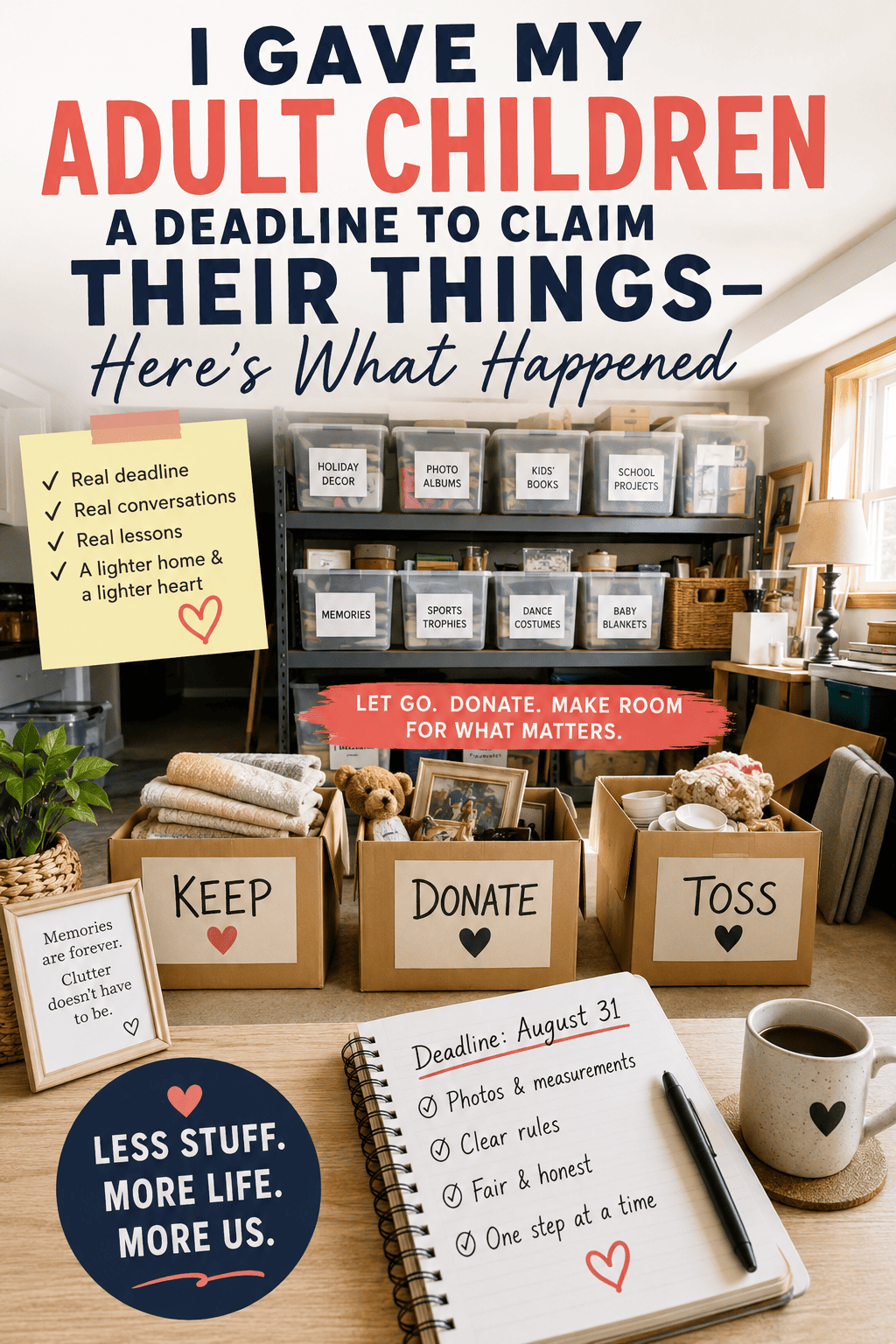
I Gave My Adult Children Until August 31 to Claim Their Things—Here’s What Happened
For three summers, I had been saying the same thing: Someone needs to deal with all this stuff.
This year, I finally followed through.
I told my adult children that anything they wanted from my basement, garage loft, or hall closet had to be claimed by August 31. Anything left behind after that would be donated, recycled, or thrown away.
There would be no more “maybe someday.” No more storing things indefinitely because someone might want them eventually.
I sent the deadline in our family group chat, along with photos, measurements, and even a spreadsheet. I expected complaints. Maybe a little guilt. Maybe someone would accuse me of trying to throw away their childhood.
Instead, what followed was a surprisingly emotional combination of practical sorting, unexpected memories, family laughter, and a lesson I probably should have learned years ago.
My Storage Spaces Had Become a Family Museum
I wasn’t dealing with a couple of forgotten boxes tucked into a corner.
I had approximately 220 square feet of storage spread across three different areas of the house.
The basement had 18 plastic bins lined along one wall. The garage loft contained 11 banker boxes and four oversized storage totes. Even the second-floor linen closet had become a dumping ground for old school projects, baby blankets, and cords nobody could identify.
For years, I justified keeping everything by telling myself, The kids might want it someday.
But my children are grown now.
One lives in a one-bedroom apartment. Another recently bought a townhouse. The third shares a place with roommates and proudly says they don’t own much furniture.
Meanwhile, I was still storing a high chair, dance costumes, childhood projects, and a bread machine that hadn’t been used since 2012.
Eventually, I realized something important: storing other people’s belongings wasn’t sentimental anymore. It was becoming another household responsibility.
Why I Picked August 31
I chose August 31 for a practical reason.
It gave everyone six full weeks to decide what they wanted and arrange transportation. It also came before the hectic fall season.
Once September arrives, schedules fill up quickly. Work gets busier, school routines change, holidays start appearing on the calendar, and suddenly a promise to “deal with it later” can stretch for another year.
I wanted a firm date that didn’t feel emotionally loaded.
August 31 wasn’t connected to a holiday or family celebration. It was simply a deadline.
And I knew that if I didn’t set one, nothing would change.
I Started With a Group Text
Rather than calling each child individually, I sent one message to everyone.
I wanted the same information reaching all three of them at the same time.
My message was simple:
“I’m clearing all storage areas. If there is anything you want, please claim it by August 31. After that, I’m donating, recycling, or tossing items. I’m happy to send photos and dimensions.”
Then I spent the next 10 days photographing everything.
I created a shared album with 143 photos showing the contents of the storage bins and boxes. I organized the pictures by category—holiday decorations, school projects, childhood books, sports trophies, framed photos, kitchen items, bedding, and furniture.
For larger pieces, I included measurements.
That turned out to be surprisingly helpful. Saying “oak bookcase” leaves room for uncertainty. Saying “72 inches tall by 30 inches wide” lets someone immediately decide whether it will fit in their home.
Three Rules Made Everything Easier
I knew this could quickly become complicated, so I established three simple rules.
Rule one: If you claimed something, you had to pick it up by August 31 or arrange a definite pickup within seven days afterward.
Rule two: If more than one person wanted the same item, I would prioritize the person who had an actual use for it rather than whoever happened to send the first text.
Rule three: Saying “maybe” did not count as claiming something.
That last rule became particularly important.
I received messages like, “I might want the Christmas village,” and “Can you hold the baseball stuff until I figure out storage?”
I had to say no.
Not an angry no. Not a dramatic no.
Just a firm, loving no.
The entire purpose of the project was to stop storing things indefinitely.
The First Things They Wanted Surprised Me
I assumed the sentimental things would disappear first.
Baby books. Handprint ornaments. School artwork. Childhood toys.
I was wrong.
The first things claimed were surprisingly practical.
One child wanted a cast-iron skillet. Another claimed a floor lamp. The third wanted a collection of mismatched Pyrex containers because, as they pointed out, “the lids actually fit, which is rare.”
That taught me something.
Adult children don’t always want the objects that represent their childhood. Sometimes they want the ordinary things that can actually become part of their adult lives.
That old skillet had been used for countless Sunday breakfasts. In a strange way, it carried more meaning than a fourth-grade paper-mâché volcano ever could.
And I found that comforting.
The Sentimental Boxes Were More Complicated
I had five medium-sized bins filled with childhood memories.
One contained school papers from kindergarten through high school. Another held Halloween costumes and recital outfits. Another contained toys I had convinced myself would cause instant nostalgia.
One Saturday afternoon, I put everything out on folding tables in the basement.
I invited everyone over between 1 and 4 p.m.
There were iced tea and brownies because if we’re going to sort through years of family memories, we might as well have snacks.
The reactions were completely unpredictable.
The baby blankets mattered.
The handwritten birthday cards mattered.
A stuffed dog with one missing eye was apparently extremely important.
But the spelling tests, participation ribbons, plastic dinosaurs, and most of the trophies?
Nobody wanted them.
At one point, one of my children picked up a “Most Improved” soccer trophy and joked that they didn’t need physical evidence of being mediocre in 1998.
We laughed.
And surprisingly, we laughed much more than we cried.
Furniture Went Faster Than Childhood Keepsakes
Once I thought about it, this made perfect sense.
Young adults can use furniture.
They don’t necessarily have room for a plastic bin labeled “miscellaneous middle school.”
A solid maple dresser disappeared quickly. So did a narrow oak bookcase, a rolling kitchen cart, and two side tables that had been buried beneath old sleeping bags in the garage loft.
One Saturday, my son borrowed a friend’s pickup truck.
In a single trip, he loaded the dresser, bookcase, and a box fan. The entire process took about 35 minutes.
Another child took the kitchen cart, eight everyday place settings, and a lamp.
I stood there watching years of “I’ll deal with this someday” leave my house before lunchtime.
It felt fantastic.
I Had to Hold My Boundary
Of course, there were a few uncomfortable moments.
One child asked me to keep two bins until winter because there wasn’t enough room right now.
Another asked if I could divide a large box into several smaller boxes and store those instead.
I understood the requests.
But I also knew exactly where that road led.
Temporary storage has a way of becoming permanent storage.
So I repeated the sentence I had prepared beforehand:
“I’m happy to help you sort, but I’m not continuing to store it.”
That sentence made all the difference.
It wasn’t angry.
It wasn’t blaming anyone.
It simply established the boundary.
In the end, the kids either took the things they genuinely wanted or admitted they didn’t want them badly enough to keep them.
That honesty probably saved me years of moving the same boxes from one corner of the house to another.
What Went to Charity
By September 1, I had accumulated 17 donation boxes and nine bags of trash.
The donations included 14 hardcover children’s books, 22 pieces of kitchenware, three table lamps, two folding chairs, 11 throw pillows, a nearly new coffee maker, four winter coats, six framed prints, and more board games than one family could reasonably need.
I divided the donations between a local charity resale shop and a nonprofit that helps families furnish apartments after housing transitions.
The second organization was especially meaningful for things like dishes, towels, lamps, and small pieces of furniture.
Knowing that those items could immediately help another family made it much easier to let them go.
I also shredded sensitive paperwork and recycled two banker boxes of old documents.
Once I saw how many of these things could actually be useful to someone else, the guilt began to disappear.
The Hardest Things to Let Go Were Actually Mine
This was the part I hadn’t expected.
I had convinced myself that I was preserving my children’s memories.
But when I really looked at the boxes, I realized that some of the items were important to me, not necessarily to them.
A tiny pair of rain boots.
A stack of construction-paper Valentine’s cards.
A hand-sewn Halloween cape I had kept for 18 years.
My children hadn’t been asking me to save those things.
I was the one who wasn’t ready to let them go.
So I made a compromise.
I created one memory bin for each child using clear 66-quart totes. Each bin was clearly labeled on all four sides.
If something didn’t fit inside the designated memory bin and nobody had claimed it, I had to make an honest decision.
Was I truly keeping it?
Or was I simply postponing the inevitable?
Giving myself a physical limit made that decision much easier.
We Ended Up Remembering More Than We Threw Away
One of the biggest surprises was how often the objects sparked stories.
A chipped mug reminded my daughter of high school theater rehearsals.
An old quilt led to a conversation about my grandmother’s sewing table.
A collection of recipe cards started a debate about who makes the best cinnamon rolls.
For the record, I still believe it’s me.
The entire mood changed.
We stopped thinking of the project as simply getting rid of things.
Instead, we started thinking of it as creating a smaller, more meaningful family archive.
We didn’t need 40 physical objects to remember one special moment.
Sometimes we just needed to tell the story.
Sometimes we took a picture before letting the object go.
And surprisingly often, that was enough.
What Each Child Took
For anyone curious about the final breakdown, here’s what happened.
My oldest took a dresser, a cast-iron skillet, two quilts, a framed family photo, a box of childhood books, and her baby book.
My middle child took the oak bookcase, a lamp, a bin of ornaments, a shoebox of letters, and three baking dishes.
My youngest took the kitchen cart, everyday dishes, a blanket, a box of sports memorabilia, and the one-eyed stuffed dog.
Altogether, they took much less than I had been storing.
Of roughly 33 boxes and bins associated with “kid stuff,” only about eight left intact with them. They also selected individual items from another seven containers.
That meant more than half of what I had preserved wasn’t important enough for anyone to take.
At first, that sounded sad.
But really, it was liberating.
The Space I Got Back
When everything was finished, I had cleared approximately two-thirds of one basement wall, nearly the entire garage loft, and the top shelf of the linen closet.
The newly available space immediately became useful.
I had room for bulk paper towels, coolers, holiday serving trays, and my collection of slow cookers—which, admittedly, may eventually need its own audit.
But the biggest difference wasn’t the amount of floor space.
It was how the house felt.
The basement looked lighter.
The garage was easier to walk through.
And every time I entered the room, I no longer felt that little burst of stress that came from seeing stacks of boxes I hadn’t opened in years.
Clutter has a hidden cost.
You pay for it with dust, decision fatigue, and a constant feeling that something needs to be dealt with.
Getting rid of it gave me back more than physical space.
It gave me peace.
What I Would Change Next Time
If I ever do another major cleanout, I’d organize everything by category from the beginning.
“Holiday.”
“School.”
“Kitchen.”
“Furniture.”
Those categories made much more sense to my children than directions like “garage loft, left side” or “basement shelf three.”
I’d also schedule one big family sorting day from the start.
And I would create a designated pickup area in the garage immediately.
Once everyone started claiming items, the garage became its own little logistical puzzle.
I eventually used painter’s tape to mark each person’s area, which saved me several text messages and one minor disagreement over a lamp that looked suspiciously similar to another lamp.
Small organizational details matter when family memories are involved.
What I Recommend If You’re Thinking About Doing This
If your home has become a storage facility for your adult children’s belongings, set a real deadline.
Give everyone enough time to make arrangements—four to eight weeks is reasonable for many families—but don’t make the deadline so far away that everyone forgets about it.
Take photographs.
Include measurements for furniture.
Create clear categories.
Set rules for pickup.
And most importantly, explain what will happen after the deadline.
Will items be donated?
Sold?
Recycled?
Thrown away?
Be specific.
Vague promises invite more delays.
Help your children sort if they need it, but don’t agree to become their permanent storage unit.
And when emotions start getting high, take a break.
Feed everyone.
I’m only half joking.
A hungry family sorting through 20 years of memories is not a recipe for peace.
Most importantly, remember that not every meaningful memory needs to remain in physical form.
Sometimes a story told around the kitchen table can preserve more than an entire box of forgotten objects.
What Happened After August 31
In the end, nothing dramatic happened.
There were no major arguments.
Nobody accused me of destroying their childhood.
Instead, my children took the things they genuinely wanted, left behind what they didn’t, and helped me finally accept something I’d been avoiding for years:
Loving my family doesn’t mean I have to store every physical reminder of our past.
Some belongings went home with my children.
Some went to families who could use them.
And a small collection of truly meaningful things stayed with me.
The morning after the deadline, I walked into the basement with my coffee.
For the first time in years, I saw open space where boxes and old obligations had been sitting.
The feeling surprised me.
It wasn’t sadness.
It was relief mixed with gratitude.
We kept the memories that still belonged in our lives.
And we allowed the rest to move on.
Honestly, I wish I’d done it two summers ago.
ADVERTISEMENT