
ADVERTISEMENT
ADVERTISEMENT
ADVERTISEMENT
T-shirts are one of the most common clothing items in the world. Almost everyone owns at least one, and they’ve become a go-to choice for comfort, style, and everyday wear. But have you ever wondered why they’re called “T-shirts” in the first place? The answer is actually much simpler than most people expect.
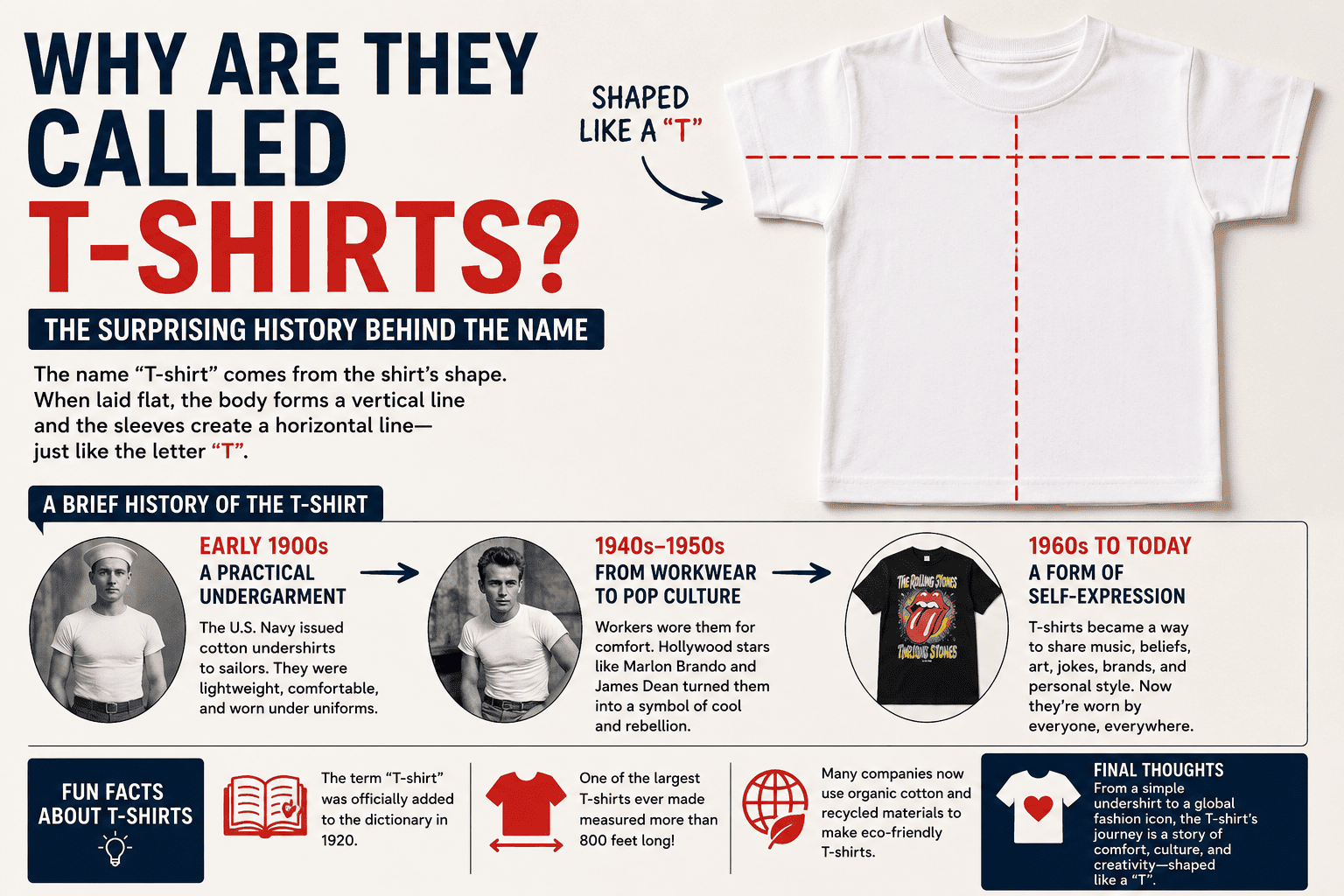
The name comes directly from the shirt’s shape. When a standard T-shirt is laid flat on a surface, the main body creates a vertical line while the sleeves extend outward horizontally, forming the shape of a capital letter “T.” That recognizable design is what gave the garment its now-famous name.
The Early History of T-Shirts
Long before T-shirts became fashion staples, they were originally designed as undergarments. In the early 1900s, lightweight cotton shirts with short sleeves were commonly worn underneath uniforms and formal clothing. They were comfortable, breathable, and easy to wash, making them especially practical for workers and military personnel.
The United States Navy helped popularize the garment by issuing white cotton undershirts to sailors. At the time, these shirts were not considered proper outerwear and were meant to stay hidden beneath uniforms.
From Undershirt to Fashion Icon
During the 1940s and 1950s, attitudes toward T-shirts began to change. Workers, farmers, and laborers started wearing them alone in hot weather because they were lightweight and comfortable.
The real transformation happened when Hollywood stars brought T-shirts into mainstream fashion. Actors like Marlon Brando and James Dean famously wore plain white T-shirts in movies, turning the once-simple undershirt into a symbol of confidence, rebellion, and cool style.
Suddenly, the T-shirt was no longer just practical clothing — it became a fashion statement.
A Symbol of Self-Expression
By the 1960s and 1970s, T-shirts evolved into something even bigger. Improvements in screen-printing technology allowed people to decorate shirts with logos, artwork, slogans, and graphics.
T-shirts became a way for people to express their personalities, interests, and beliefs. Music fans wore band shirts, activists used printed slogans during protests, and businesses began using T-shirts for advertising and branding.
Today, T-shirts come in endless styles, colors, and designs, making them one of the most versatile clothing items ever created.
Interesting Facts About T-Shirts
- The term “T-shirt” officially entered the dictionary in the early 1920s.
- T-shirts are among the most produced garments in the world.
- Many modern brands now create eco-friendly T-shirts using recycled fabrics and organic cotton.
- Graphic T-shirts became especially popular during the pop culture boom of the 1970s and 1980s.
Final Thoughts
The name “T-shirt” may sound ordinary today, but it comes from the garment’s simple T-shaped design when laid flat. What started as a practical undershirt for workers and sailors eventually became one of the most recognizable fashion items in history.
From casual everyday wear to bold personal statements, T-shirts have remained popular for more than a century — proving that sometimes the simplest designs become the most timeless.
ADVERTISEMENT