
ADVERTISEMENT
ADVERTISEMENT
ADVERTISEMENT
A Lifetime of Memories Hidden in Boxes
For years, my family photos were scattered everywhere — stuffed into old albums, tucked inside drawers, buried in attic bins, and hidden in dusty shoeboxes. Every pile held priceless memories, but the overwhelming clutter made it impossible to truly enjoy them. I kept telling myself I’d organize them “someday,” but someday kept getting pushed further away.
Eventually, I realized those photos represented more than snapshots. They were pieces of our family history, moments that deserved to be preserved and shared instead of forgotten in storage. So, after decades of procrastination, I finally committed to organizing nearly 40 years of family photos using a surprisingly simple system: the shoebox method.
What started as a practical project quickly became emotional, nostalgic, and unexpectedly life-changing.
Facing Four Decades of Photo Chaos
The first step was gathering every single photo from around the house. I pulled dusty boxes from closets, carried old albums down from the attic, and searched every forgotten storage space I could find.
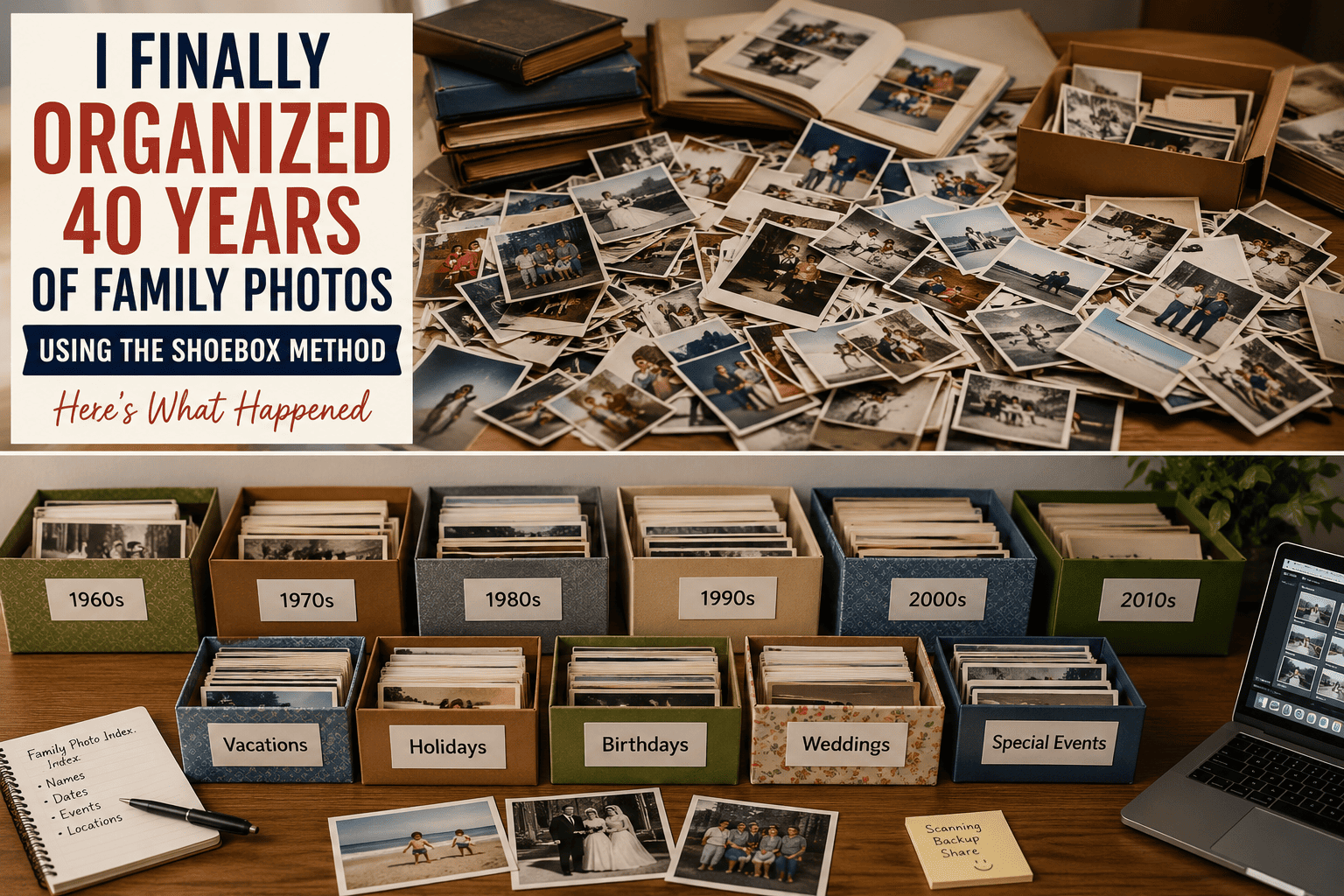
By the time I finished collecting everything, I realized I was dealing with thousands of photos — probably between 5,000 and 7,000 images spanning multiple generations. There were faded Polaroids, glossy prints from the ‘90s, curled snapshots, negatives, and even old slides.
Seeing everything piled together was intimidating, but it also reminded me just how much life these photos captured.
What the Shoebox Method Actually Is
The shoebox method is exactly what it sounds like: organizing photos into simple shoebox-sized containers based on categories, decades, or events.
Instead of creating an overly complicated filing system, I used labeled boxes to separate memories into manageable sections. One box held childhood photos, another focused on holidays, while others were divided by decades, vacations, weddings, and family milestones.
What made this method so effective was its flexibility. It didn’t require expensive equipment or perfection. It simply created structure without adding stress.
Collecting Photos From Every Corner of the House
Tracking down all the photos turned into a project of its own. I spent an entire weekend climbing into the attic, digging through storage containers, and flipping through forgotten albums hidden under beds and inside cabinets.
Some photos were beautifully preserved, while others were faded, bent, or stuck together from age. Holding those old prints felt surprisingly meaningful in a world where most memories now live on phones and cloud storage.
There was something powerful about physically touching moments from decades ago.
The Emotional Impact of Sorting Old Photos
I expected the project to be time-consuming, but I didn’t expect it to feel so emotional.
As I sorted the photos, memories came flooding back. I laughed at old hairstyles and awkward fashion choices, smiled at birthday parties I’d forgotten about, and paused at photos of relatives who are no longer here.
Some pictures triggered stories I hadn’t thought about in years. Others revealed moments I was too young to remember at all.
The process became less about organization and more about reconnecting with family history.
Building a Sorting System That Actually Worked
To keep the project manageable, I created a simple system:
- One shoebox per decade
- Dividers for major life events
- Labels for holidays, vacations, birthdays, and weddings
- Sticky notes for unidentified people or unknown dates
The beauty of the shoebox method was that it stayed flexible. I could easily rearrange categories, add new sections, or move photos around without starting over.
Instead of aiming for perfection, I focused on progress — and that made all the difference.
The Hardest Part: Deciding What to Keep
One of the most difficult parts of the process was deciding which photos to let go of.
There were duplicates, blurry shots, accidental finger-over-the-camera pictures, and dozens of nearly identical vacation photos. At first, throwing any photo away felt wrong.
Eventually, though, I realized that preserving meaningful memories mattered more than keeping every single print. Letting go of low-quality or repetitive images helped the truly special photos stand out.
It was surprisingly freeing.
Turning Shoeboxes Into a Real Family Archive
Once everything was sorted, the shoeboxes transformed from clutter into a usable archive.
I labeled each box clearly and created a digital index listing important people, dates, and events. Suddenly, finding a specific memory no longer required digging through random piles for hours.
The system was simple, but it worked incredibly well.
For the first time, our family photos felt organized, accessible, and protected.
The Unexpected Stories That Resurfaced
As I worked through the photos, forgotten stories resurfaced everywhere.
I discovered pictures from family road trips I barely remembered, snapshots of relatives as teenagers, and candid moments that revealed entirely new sides of people I thought I knew well.
Some photos sparked conversations with relatives who filled in missing details and shared stories I had never heard before.
The project didn’t just organize memories — it revived them.
What the Photos Taught Me About Family and Time
Looking through four decades of photos gave me a completely different perspective on my parents, grandparents, and even myself.
I saw my parents long before they became parents. I saw younger versions of relatives I’d only known later in life. I watched children grow into adults and families evolve over time.
The photos became a reminder of how quickly life changes and how important it is to preserve the moments that matter.
Adding a Digital Backup for Future Generations
After sorting the physical photos, I decided to digitize the collection.
I scanned important images, created digital folders, and backed everything up to multiple locations. I also shared albums with relatives so family members across different cities could enjoy the memories together.
Digitizing the archive added an extra layer of protection while making the photos easier to access and share.
How the Shoebox Method Changed the Way I See Family Memories
Before this project, our family photos felt like overwhelming clutter. Afterward, they became something completely different — a carefully preserved story of our family’s life over four decades.
The shoebox method turned a stressful project into a meaningful experience. It taught me that organizing memories doesn’t need to be perfect or expensive to be worthwhile.
More importantly, it reminded me that photos are more than paper prints. They are pieces of identity, connection, and legacy that deserve to be preserved for future generations.
In the end, I thought I was organizing old photos. What I was really doing was rediscovering my family’s story.
ADVERTISEMENT